




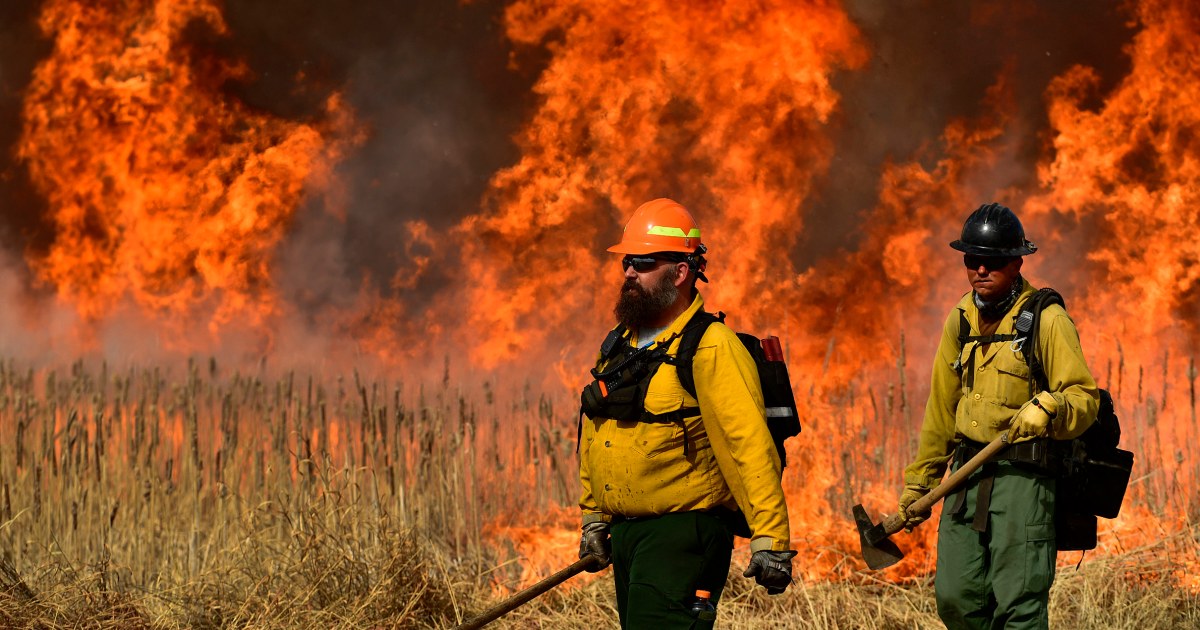
For the first time, federal firefighters will be encouraged to wear respirators to protect them against smoke-related hazards as they work to put out wildland blazes.
Subscribe to read this story ad-free
Get unlimited access to ad-free articles and exclusive content.

The Forest Service announced Wednesday that firefighters were authorized to use N95 respirators on the fire line, a major policy reversal as the agency for decades did not allow such protections, even as studies demonstrated the health harms of wildfire smoke.
“It’s long, long overdue,” said George Broyles, a longtime Forest Service firefighter who has researched wildfire exposure risks. “There’s no doubt that our men and women out there are at higher risk of cancer and heart disease.”
To Broyles, the policy change represents a long-awaited acknowledgment from the Forest Service that wildfire smoke is toxic and that the agency ought to find ways to reduce its workers’ risks.
The Forest Service has been slow to address the health effects of wildfire smoke and to enact worker protections in the difficult-to-control environment of a wildfire.
When wildfire smoke is inhaled, volatile gases and tiny particles can pass through the lining of the lungs and enter the bloodstream. In the broader U.S. population, exposure to this smoke is associated with asthma, lung cancer and other chronic lung problems, as well as preterm birth and pregnancy loss. Wildland firefighters have a higher risk of lung cancer and cardiovascular disease, studies suggest.
The Forest Service also announced that it is initiating a decontamination program designed to reduce firefighters’ skin exposure to the toxins in soot and ash. Workers will be paid for the time they spend washing clothes, cleaning their vehicles and showering after working on a fire.
The agency described the new policies as an interim step as it pursues a more robust protection program that complies with the requirements of the Occupational Safety and Health Administration.
“As we work toward a full respiratory protection program, we’re not going to wait any longer. We think N95s can be used in a practical way that can provide some level of protection and if people are getting overheated, they can take it off,” said Evan Burks, a Forest Service spokesperson. “This is not a requirement, but we are allowing it and basically encouraging it.”
The announcement came as Congress increases its scrutiny of the agency’s protections for firefighters. In a news conference Wednesday, Rep. Maxine Dexter, D-Ore., previewed a bill to create a health program for federal wildland firefighters. The proposed legislation would bring together a task force and outline a strategy to implement respiratory protection, limit skin exposure and offer long-term medical monitoring, among other initiatives, according to a draft reviewed by NBC News.
“For nearly 30 years, the federal government has known that wildland firefighters face serious long-term health effects from smoke,” she said. “This is a moral failure. This is a government failure, and I am fighting to change that.”
Dexter added that the bill was still being finalized.
As wildfires grow in size and intensity, researchers have been racing to understand the harms of smoke. Wildland firefighters are among the most at risk for chronic smoke-related conditions.
A 2019 study, which Broyles co-authored, estimated that career wildland firefighters were 8% to 43% more likely to die of lung cancer and 16% to 30% more likely to die of cardiovascular disease, depending on the length of their career and the number of days of exposure. Another study showed wildland firefighters were far more likely to be diagnosed with hypertension and irregular heartbeats.
“Access to N95s, decontamination protocols, and training can help reduce exposure to harmful smoke and contaminants,” said Steve Gutierrez, a union representative with the National Federation of Federal Employees. “Now we need to continue building on this progress with long-term respiratory protection, cancer screening, medical monitoring to catch illnesses and disease early, as well as facility improvements like washing machines to decontaminate clothing before they bring carcinogens back to their families.”
N95 respirators are not a perfect solution. They can be hot and uncomfortable and can also increase the effort required to breathe during demanding physical activity. Plus, although they are designed to prevent tiny particles from entering the body, they do not protect against carbon monoxide, formaldehyde and other toxic gases that can come from fires.
The respirators are not meant to be worn in particularly steep terrain, in fast-changing fire conditions or when a firefighter might make direct contact with flames, according to a Forest Service fact sheet.
“There is nothing that exists right now that fits the job,” said Riva Duncan, president of Grassroots Wildland Firefighters, a nonprofit advocacy group of current and former federal wildland firefighters. She described N95s as “another bandaid.”
Still, a more comprehensive respirator system compliant with OSHA regulations could be “years and years” away from success, Broyles said.
He and Gutierrez both said that many firefighters might choose not to wear the N95 respirators.
“I think it will be a culture-changing process,” Gutierrez said.
The Forest Service said in its announcement that it will require fire managers and firefighters who want to use respirators to participate in a training program.
This summer could be especially difficult for wildland firefighters. According to the National Interagency Fire Center, more than 34,000 wildfires have already burned at least 2.7 million acres this year; both figures are above the 10-year-average.
Many states in the West, including Utah and Colorado, experienced all-time low snowpacks this spring and are deep in drought, which raises fire risk. Meanwhile, a strong El Niño pattern is in effect, which can be expected to raise average global temperatures.
The fire center’s forecast maps show large areas of above-average potential for wildfires through September. No areas are shown with “below-normal” potential.

