




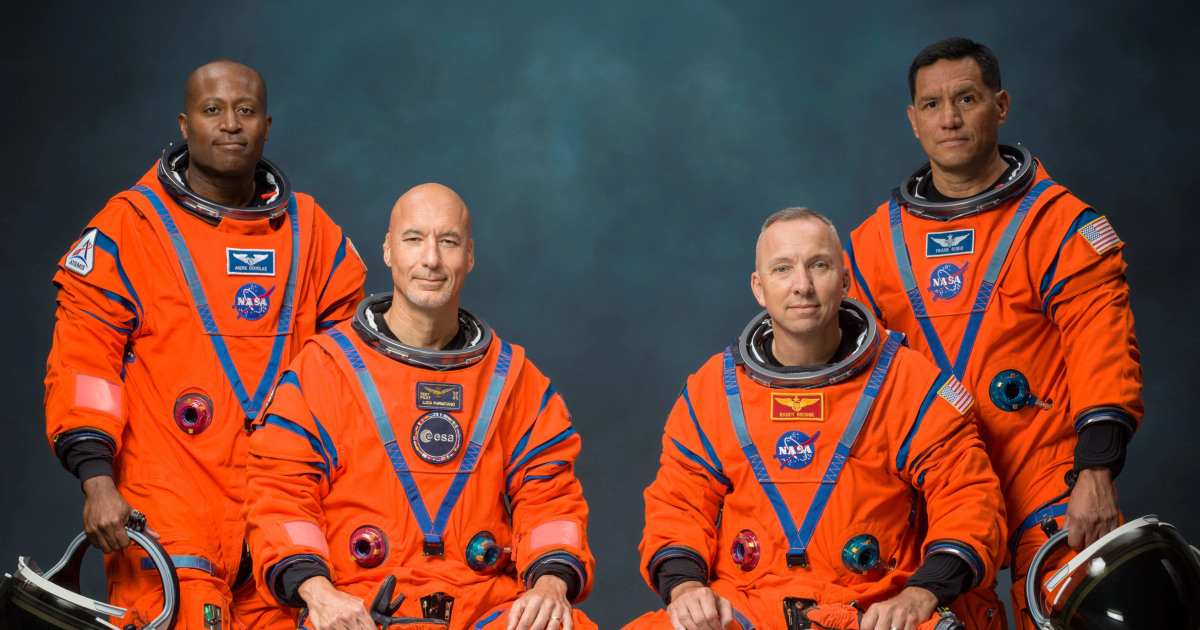
NASA on Tuesday named the four astronauts it plans to send on the Artemis III mission, the next major step in its return-to-the-moon program.
Subscribe to read this story ad-free
Get unlimited access to ad-free articles and exclusive content.

Randy Bresnik, Luca Parmitano, Frank Rubio and Andre Douglas are expected to launch into Earth orbit next year, with the goal of testing out two commercially built lunar landers being developed to carry astronauts to the surface of the moon in 2028. Bresnik will be the mission’s commander, with Parmitano, an Italian astronaut with the European Space Agency, serving as the pilot. Douglas and Rubio will be mission specialists, and Bob Hines will train with the crew as a backup member.
Elon Musk’s SpaceX and Jeff Bezos’ Blue Origin are racing to build the landers that Artemis III aims to test. Both companies said in updates Tuesday that they expect their landers to be ready.

“This test flight will enable us to prove we can carry out highly choreographed operations with our partners across hardware interfaces, software propulsion systems and life support elements with crew in the high-stakes space environment,” said Jeremy Parsons, NASA’s Artemis program manager.
Bresnik, a Californian, has been on two missions to the International Space Station, most recently as commander of an expedition in 2017. A retired U.S. Marine colonel, he was selected as a NASA astronaut in 2004. Bresnik has helped oversee development and testing of spacecraft for the Artemis program as an assistant to the chief of the Astronaut Office, which manages astronaut training and operations.

Parmitano, a father of two, also served as commander of a space station expedition in 2019 — his second stint on the ISS. While there, he completed a total of six spacewalks and also performed the first live DJ set in orbit. Before becoming an astronaut, Parmitano was a test pilot for the Italian air force.
For Rubio, a physician and father of four with 28 years of service in the U.S. Army, Artemis II would be his second trip to space. From 2022 to 2023, he spent 371 days on the space station, breaking the record for longest-duration space flight by an American, according to NASA.
Artemis III will be Douglas’ first space flight. An engineer who previously worked on space exploration and robotics at Johns Hopkins University Applied Physics Lab, he became a NASA astronaut in 2022. It will be his first spaceflight.
“My brain is going a mile a minute right now, but my heart, my heart, it is so warm,” Douglas said during the NASA announcement.
Hines, a former U.S. Air Force pilot who has spent 170 days in space during two previous missions, will train alongside the crew to step into any role, if needed.
The Artemis III mission is expected to last about two weeks, Parsons said — roughly four days longer than the Artemis II mission around the moon earlier this year. It’s intended to be the Artemis program’s final testing mission. If it’s successful, NASA then plans to land a crew on the moon with the subsequent mission, Artemis IV.
“Every aspect of Artemis III will give us insight into how to refine our plans for Artemis IV,” Parsons said. “This mission is deliberately designed to take calculated risks, so that future crews will be safer and ultimately successful when we put boots on the lunar surface.”
Eventually, NASA’s Artemis program aims to establish a sustained human presence on the moon. The space agency announced plans this year to spend $20 billion to build a base on the lunar surface.
Initially, NASA had planned for the Artemis III mission to land astronauts on the moon, but NASA Administrator Jared Isaacman overhauled the program this year to add missions and increase the pace of launches ahead of a moon landing attempt.
So the plan for Artemis III crew is now to stay closer to Earth and test rendezvous and docking operations with the moon landers from SpaceX and Blue Origin. These maneuvers are essential because NASA’s moon-landing plan calls for one of these landers to meet up with its Orion spacecraft — the capsule that carried the Artemis II crew in April — while orbiting the moon. Two astronauts would then transfer to the lander, which would carry them down to the lunar surface. While there, the spacecraft would serve as their living quarters. To finish the mission, the lander would blast off the moon’s surface, then redock with Orion, which would take the crew back to Earth.
If it all works out as planned, the U.S. could pull off its first moon landing in more than 50 years — and do so before China puts its own astronauts on the lunar surface, which the country plans to accomplish by 2030.
Parsons said key elements of the Artemis III program are coming along nicely. A redesigned heat shield for NASA’s Orion spacecraft, for example, has been built and tested, he said. During the Artemis II mission, some critics were concerned about that heat shield because it had sustained damage during the uncrewed Artemis I mission.
“Our improved heat shield has been fully inspected and is ready to be installed,” Parsons said.
However, questions remain about whether Blue Origin will be ready to launch its lander for the Artemis III mission. The company recently suffered a major setback when one of its rockets exploded during an engine test. The fireball destroyed the New Glenn rocket — the system Blue Origin would use to launch its lunar lander into space — and caused extensive damage to the company’s only operational launch pad.
On Tuesday, however, John Couluris, senior vice president of lunar permanence at Blue Origin, expressed optimism about the company’s timeline.
“Manufacturing is well underway on the Artemis III Mark 2 lunar crew module, our storable reaction control system, our docking systems, and our environmental control and life support system. Our factories are running around-the-clock shifts in a responsible manner,” he said. “We expect to complete the vehicle for Artemis III and be ready for launch in 2027.”
Just days before the Blue Origin explosion, NASA had awarded the company a contract to deliver payloads to the moon on an uncrewed mission later this year — the first in a series of robotic missions NASA is planning in preparation to land a crew. Through those missions, NASA intends to scout the moon’s south pole and test technologies that future Artemis astronauts could use there. Given the recent explosion, it’s unclear whether Blue Origin will be able to complete that mission as planned this year.
For the Artemis III launch, NASA plans to use the same setup it did for Artemis II, sending the newly announced crew into orbit in its Orion spacecraft, which will lift off atop its Space Launch System rocket from Kennedy Space Center in Cape Canaveral, Florida.
“Every single mission we will do after this will be more challenging and more complex,” Bresnik said, adding that the crew sees itself as the crucial link between the Artemis II flight and the ambitious goals for Artemis IV, “where we will again be the first to land humans on another celestial body.”

