




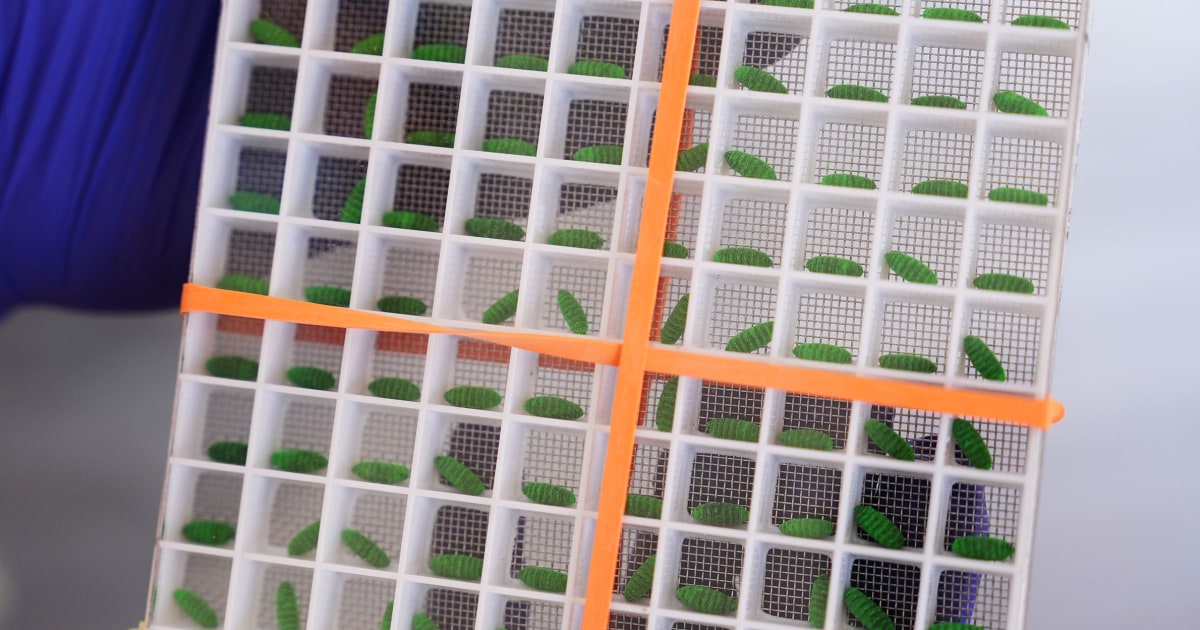
The United States spent more than half a century and hundreds of millions of dollars driving the flesh-eating New World screwworm as far from its borders as possible. Now, it’s back.
Subscribe to read this story ad-free
Get unlimited access to ad-free articles and exclusive content.

The species can eat the tissue of any warm-blooded animal, but it’s a particular threat to livestock and is often fatal for cattle. Some environmentally minded bioethicists have openly debated whether it would be moral to deliberately drive the screwworm into extinction.
“There are some species that it’s worth considering wiping out altogether and I do think the screwworm is one,” said Gregory Kaebnick, a senior research scholar at the Hastings Center for Bioethics.
The Agriculture Department announced Wednesday that the New World screwworm had been found in a calf in Texas — the first detection in U.S. cattle during a natural incursion since 1982. The agency reported a second case Friday. It was discovered about six miles from the first infection. The discovery represents a worrisome comeback for the species and a failure in containment for the U.S., reprising a decadeslong battle the country waged once already.
Experts said the U.S. will run much the same playbook as it did starting in the late 1950s, when the government embarked on an aggressive, multinational fight against the screwworm. Because female screwworms only mate once, the strategy is to mass-produce sterile males and release them into the wild, where they serve as reproductive dead ends.
“It is a tremendous strategy. It has worked and will continue to work moving forward,” said Chad Cross, a professor of parasitology at the Texas Tech University School of Veterinary Medicine.
He added that the new Texas case “is a stark reminder of how quickly we need to act to ensure that it doesn’t spread further.”
The screwworm is not a worm at all, but a species of blowfly native to the southern U.S. The flies are attracted to rotting, unkept wounds. Females can lay 200 to 300 eggs, which grow into larvae that look like wood screws and burrow into flesh.
“The larvae that emerge from the eggs consume the flesh of warm-blooded animals,” said Phillip Kaufman, a professor of entomology at Texas A&M University. “It’s a pest of all of our livestock, most of our wildlife and our companion animals, our cats, our dogs and ourselves.”
Screwworm larvae — or maggots — have special mouth hooks to tear into an animal’s flesh and burrow deeper. As the maggots multiply, the wound becomes an open, rotting sore on the surface of the animal’s skin, sometimes attracting other fly species with the smell of rotting flesh. Unless the larvae are removed and an animal is given larvicide and antibiotics, the infections are typically deadly.

For humans, infections are extremely painful though uncommon.
“It’s eating your tissue, whether that be muscle or fat or skin,” Kaufman said. “There is little to no way that you would not know that you have this problem.”
Kauffman said screwworms are native to only the southernmost parts of the U.S., though they can range into more temperate climates when it’s warm enough.
“When weather conditions are good, it will survive in the Midwest, but it can’t survive the winters,” Kauffman said. “South Texas and South Florida never get cold enough to kill it off.”
Those are the main places the species lived in the U.S. until the 1960s, when the U.S. ramped up its war on the screwworm. Over the next four decades, factories and dispersal sites were built in Florida, Texas and Central America that produced and released hundreds of millions of sterile flies each week.
The sterile flies are irradiated and released en masse, designed to blanket a region experiencing an outbreak. Their presence makes it nearly mathematically impossible for wild female screwworms to find and select a nonsterile mate. Without viable mates, the flies can’t lay their eggs and reproduce.
The strategy worked: Once cases reached zero in 1982, the U.S. continued its campaign in Mexico and other Central American countries, driving the screwworm farther and farther south.
“It took us until about 2004 to eradicate it all the way down past the Panama Canal,” Kaufman said.
But in time, he added, the U.S. and its partners stopped investing in facilities that produced and dispersed the sterile insects in locations where the screwworms had been eradicated.
“As they open the new plants further south, they close the northern plants, and so the Texas plant closed, and then Mexico, and then the Nicaragua plant, leaving us only with the plant in Panama,” Kaufman said. “That plant is showing its age.”
For about two decades, the Darién Gap, a forbidding, roadless rainforest on the border of Panama and Colombia, represented the geographic border of the screwworms’ reach. However, in 2023, an outbreak of screwworm began spreading north, first to Panama and Costa Rica, then to Mexico and now to the U.S.
“Why did it get out?” is the golden question, Kaufman said. “No one really knows.”
Regardless of the answer, the U.S. is investing once again. The USDA is spending $750 million to build a facility that will produce about 300 million sterile screwworms each week in Texas, which is about three times the amount possible today and similar to what could be produced in the 1960s. But the facility won’t be operational until late 2027 at the earliest, and it will take longer to produce at full volume.
Until the facility is online, the risk of an outbreak will be high. A widespread screwworm outbreak could cost the Texas economy alone about $1.8 billion a year because of livestock deaths, veterinary services, treatments and extra labor, according to USDA estimates from 2024.
While the goal will be to push screwworm out of the U.S. and Central America, some researchers think it’s worth considering getting rid of the species altogether. A group of bioethicists, conservation biologists and scientists gathered in 2024 to discuss whether it would make sense to tweak the sterilization technique and use genetic modification to ensure lethal genes spread into the screwworm’s gene pool to doom the species. The group published its perspective in the journal Science last year.
The screwworm, the authors wrote, has caused immense suffering to the livestock for which humans have a responsibility to care. The infections it causes are slow and painful for both animals and people, the paper said, and it’s not clear what value or environmental benefits the species offers.
Kaebnick, the bioethicist, said the group was filled with people predisposed to celebrating the web of life and preserving species. And yet: “We came to the conclusion there could be cases where it would make sense.”
The researchers were dealing mostly in speculation — the gene modification technology that scientists could use to doom the screwworm is untested at scale and not ready to be deployed. If it does become an option, that would be a weighty decision that could set a dangerous precedent, Kaebnick said.
“Those things aren’t ready for release just yet,” he said.

