




GIZA, Egypt — They’re the crown jewels of the Grand Egyptian Museum — two galleries devoted to the ancient pharaoh Tutankhamun.
Showcasing more than 5,300 objects from the young king’s tomb, including his iconic death mask and glittering royal regalia, the new section of the vast museum here on the outskirts of Cairo is expected to draw millions of visitors every year. The galleries, displaying mostly pieces never seen by the public, will hold its grand opening ceremony on Saturday.
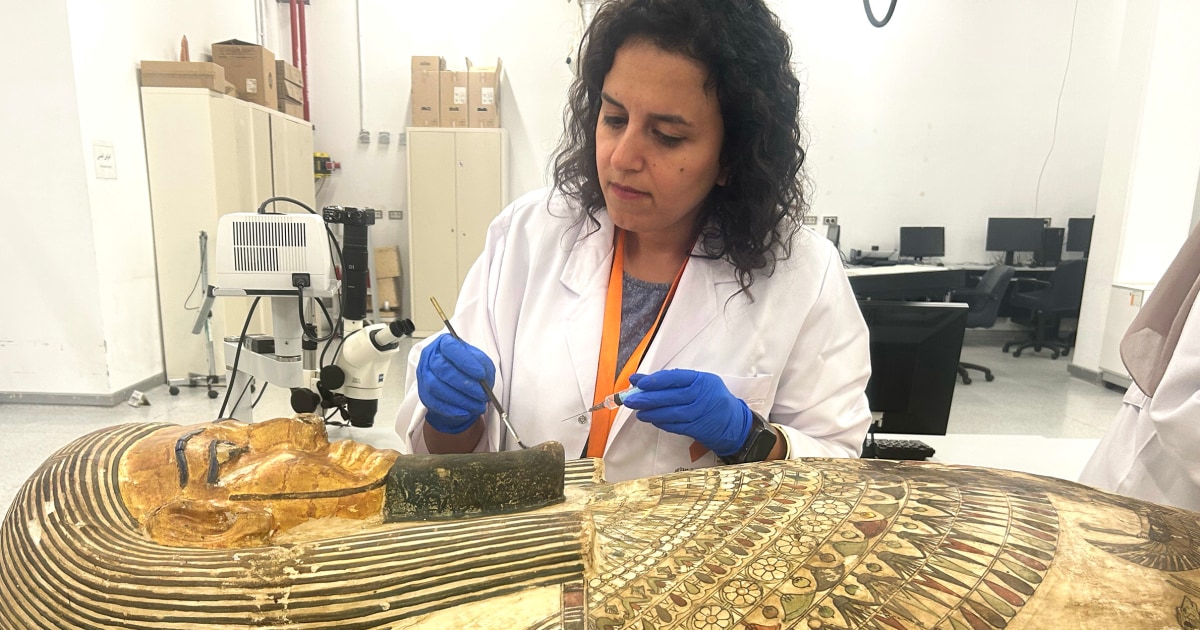
Details about the event are a closely guarded secret, but on a behind-the-scenes visit to the museum’s Conservation Center earlier this month, general director Hussein Kamal told NBC News that it will be the first time since Tutankhamun’s tomb was discovered over a century ago that all the items are stored in one place.
“It’s wonderful,” he said, adding that he was particularly excited by the exhibition featuring King Tut’s armor. The piece made from textiles and leather was “unique throughout ancient Egyptian civilization,” he said.


Kamal said the items, previously held in a storeroom, were painstakingly restored since 2017 by some of the center’s 150 conservators.
“We tried to reshape it from the original,” he said, adding that it was a challenge because they did not have anything to compare it to and had to depend on “investigation and analysis to know the original structure of the armor.”
Believed to have become pharaoh when he was 8 or 9 years old, in around 1334 B.C., Tutankhamun ruled until his death 10 years later. He is believed to have suffered from numerous illnesses and disabilities, including circulatory problems, malaria, bone disease and a club foot.
Tutankhamun’s tomb was discovered in November 1922 in the Valley of the Kings by the British archaeologist Howard Carter, undisturbed by grave robbers and almost completely intact, nearly 400 miles south of Egypt’s most famous archeological treasures in Giza.

Now the artifacts recovered from that tomb will sit in the largest museum in the world dedicated to a single civilization — the Grand Egyptian Museum’s grounds cover 117 acres, or the equivalent of 80 football fields, just over a mile north of the Great Pyramids of Giza outside Cairo.
The collection also includes the 4,000-year-old funerary boat, also known as the Cheops ship, of Pharaoh Khufu.
While the museum will officially open Tuesday, limited tours have been available since 2023, and the public is allowed access to most of its main galleries since October.

Alongside the Tutankhamun exhibition, the museum holds artifacts from the prehistoric era, dating from 700,000 B.C., to the Roman era of the fourth century A.D., arranged around themes of kingship, society and beliefs.
Statues, sarcophagi and stelae also offer a glimpse into the life of Egypt’s ancient elite and how they prepared themselves for the afterlife.
At the museum’s center sits the six-story Grand Staircase with a view of the pyramids and an atrium containing monuments, pharaonic statues and sarcophagi.
The opening ceremony will be the culmination of a project first announced in 1992. Construction officially began in 2005 and has been hit by repeated delays due to the Arab Spring in the early 2010s and the Covid-19 pandemic.
Ahmed Ezz, the chairman of Ezz Steel, which provided all of the steel rebar needed for the project, said in an interview this week that the museum not only reflects his country’s past but is “also part of an architectural renaissance of Egypt.”
After a “difficult decade,” Ezz said he hoped the museum would show that his country was “going on a more positive trajectory.”
